Billing Controls
The entity of the hierarchy contains the controls for the frequency, structure and content of customer bills.
For more information, see the Agreement topic.
Key features of billing controls are:
The day of the month when cyclical bills are triggered. This can be configured as any day between 1 - 31 days. See also Next Expected Invoice Date.
CMP cyclical billing supports monthly billing based on any day (1-31) of the month. Where a cycle does not exist in a month (e.g. 31 in a month with 30 days) the customer is billed on the last day of the month. Bill cycles other than monthly can be set on a daily basis between 1-999 days.
Cyclical billing can be carried out on a daily, weekly, monthly, quarterly, bi-annual or annual basis and is set and managed via at Agreement level.
A customer's billing date defaults to the first cycle date available after their connection date. The bill cycle date can be changed at any time via AgentView.
Any changes to the Bill cycle will apply to all subscriptions attached to the agreement.
In a real-time charging () environment, when a post-paid 's bill cycle day is changed, the external RTC system creates new allowance and records that take effect at the start of the subscription's new bill cycle.
These new records must be synchronised with CMP records in order to allow for real-time enquiry of allowance and spend balances from CMP.
Following a bill cycle change, new records generated by the RTC system are stored in CMP. When the new records are due to come into effect, the Bill Cycle Change batch job is triggered to update CMP allowance and spend cap records to refer to the new records.
For more information, see the CMP Batch Jobs and JSON Schemas Guide.
The number of days or months between bills.
This is the date the Agreement becomes eligible for invoicing and is a key factor in the selection criteria used by CMP to determine when to generate a bill for a . Each time the subscriber is billed, the bill cycle and invoice frequency are used to set the Next Expected Invoice Date to the appropriate future date. CMP automatically adjusts for short months.
The level of the hierarchy at which charges should be grouped for billing. This ultimately determines how many bills are produced for the subscriber and where the debt sits on the customer hierarchy.
Agreements can be logged at the level or higher in the CMP customer hierarchy. The level at which the agreement is logged determines the options available for consolidating charges into bills.
Agreements logged at Account level can have Subscription-level or Account-level consolidation.
- Subscription-level consolidation results in individual bills for each Subscription linked to the Agreement.
-
Account-level consolidation results in a single bill containing the charges for all Subscriptions below that Account entity that are linked to the Agreement.
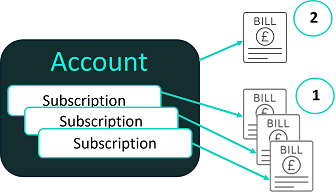
Account-level Logging
Agreements logged at Corporate level can have consolidation at the Subscription, Account or Corporate level.
- Corporate-level consolidation results in a single bill containing the charges for all Subscriptions below that Corporate entity that are linked to the Agreement.
- Account-level consolidation results in separate bills for each Account below the Corporate entity that has Subscriptions linked to the Agreement.
-
Subscription-level consolidation results in individual bills for each Subscription linked to the Agreement.
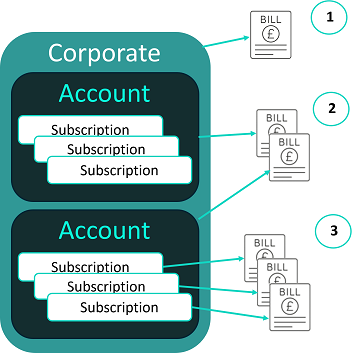
Corporate Level Logging
Agreements logged at Group level can have consolidation at the Subscription, Account, Corporate or Group level consolidation.
- Group-level consolidation results in a single bill containing the charges for all Subscriptions below that Group entity that are linked to the Agreement.
- Corporate-level consolidation results in separate bills for each Corporate below the Group entity that has Subscriptions linked to the Agreement.
- Account-level consolidation results in separate bills for each Account below the Corporate entity that has Subscriptions linked to the Agreement.
-
Subscription-level consolidation results in individual bills for each Subscription linked to the Agreement.
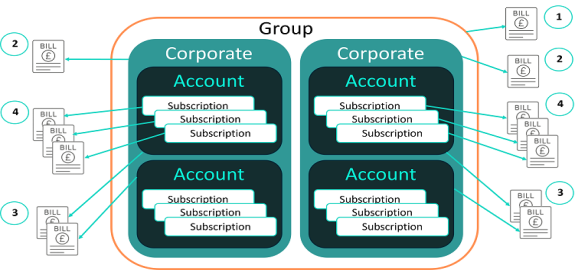
Group Level Logging
The media and format to be used outside of CMP for the bills produced, for example e-billing, Braille or audio.
Govern when first and final bills are produced, either on the normal bill cycle, or a configurable number of days after connection or disconnection.
First and final invoice controls allow first and/or final invoices to be sent on the cycle day or sent off cycle. For example:
- It is common for a to send a first bill in the next bill run after connection, to get early sight of a customer’s willingness to pay.
- Final bills are typically sent a small number of days after disconnection rather than waiting until a customer’s next cycle.
Where first/final bills are set to be triggered off cycle, a configurable number of days delay can be set from connection/disconnection respectively. This is configured against a Subscriber’s Tariff.
 In the Cloud Monetisation Platform, the entity that holds the instructions for generating the bills for one or more subscriptions. including the addresses and how often the bill is generated. entity of the CMP