About Payments
CMP Converged Monetisation Platform. The MDS Global product that supports customer care and billing for digital service providers. Payment functionality allows subscribers to make payments and have those payments reflected on their CMP account In the Cloud Monetisation Platform, a billing entity that can be used to manage payments on one or more subscriptions or payments for services. An account can hold details such as payments or invoices..
Payments can be made directly from AgentView The graphical user interface of the CMP that is typically used by Customer Service Agents to access CMP customer and billing data. In versions prior to CMP 8.0, this was called the CMP GUI. or taken via third party Of software; a reusable component developed to be either freely distributed or sold by an entity other than the original vendor of the development platform. applications such as sales order portals, selfcare applications, and Integrated Voice Recognition (IVR Interactive Voice Response.
An automated customer management interface that accepts voice and phone tone input to allow limited self-management of an account.) using web services. Service providers can accept non-recurring payments via third parties outside of CMP.
CMP supports the following:
- Recurring Payments (post paid and prepaid)
- Non-recurring payments
- One-off payments
- Payment rejections
- Payment reversals
- Bond payments (Account Bonds)
- Refunds
Payment methods include:
- Manual payments, for example cash or cheque
- Direct debit payments
- Credit or debit card payments
In CMP payment methods can be set up, amended or cancelled.
Payment methods are set up when a customer In the context of the Cloud Monetisation Platform, an individual or organisation who has signed an agreement to take goods and services from a service provider. A customer receives a bill associated with one or more subscriptions, and can be a single end user or a large company with many subscriptions assigned to one agreement. account is created. This can take place in AgentView or via a web service XML- or JSON-based information exchange systems that use the Internet for direct application-to-application interaction. These systems can include programs, objects, messages, or documents. where Payment Type is a parameter, for example the Create Account SOAP web service.
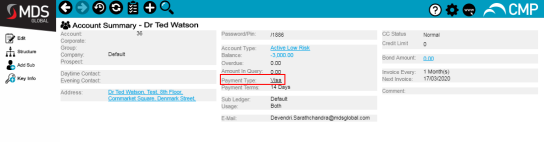
The chosen payment method is displayed as the Payment Type on the Account Summary and Subscription A billing entity that incurs a charge. Examples include a network attached device whose usage you want to measure and charge for, or a monthly software subscription Summary screens in AgentView. The payment method can be changed in AgentView via the Payment Type hyperlink in the Account Summary:
Direct Debit and Card Payments
Customers who choose to pay by direct debit or credit/debit card have the amount due claimed directly from the appropriate account by the service provider The owner of the infrastructure in which accounts will be created. The Service Provider can host and operate the instance of CMP, or CMP can be provided as a Managed Service..
In the United Kingdom, direct payments from customer bank accounts are requested by means of Bankers Automated Clearing System (BACS Bankers Automated Clearing Services. A system in the United Kingdom for making payments directly from one bank account into another.) transmissions. Other systems such as the Single Euro Payments Area (SEPA) are in use in other parts of the world. Service providers can use a third party payment handler to manage the transfer of BACS Direct Debit Scheme files from CMP to BACS and vice versa. This option is controlled at a CMP environment level. CMP produces files in BACS standard format, so no file conversion is usually required. Integration to a third party payment handler is considered during individual customer implementation. Examples of third party payment handlers include Albany/Bottomline, Experian, and PaymentTech.
Third party payment providers allow credit or debit card payments to be taken and stored in line with the Payment Card Industry Data Security Standards (PCI DSS Payment Card Industry Data Security Standard. An information security standard for organizations that process card payments, the PCI DSS enforces standards for the storage, transmission and processing of cardholder data, so that businesses can process payments securely, reduce fraud, and protect cardholder data.). All recurring and one-off credit/debit card payments are taken outside of CMP
Cyclical billing allows the payment to be claimed on any day of the month, as previously agreed with the customer. This function is carried out electronically and automatically. When a customer is invoiced the system automatically calculates a due date by which time payment is expected to have been received.
It is not possible for a customer to use both Credit/Debit Card and Direct Debit as a Payment Type simultaneously.
Payments and Sales Ledger
All payments received are automatically posted to the sales ledger, adjusting the customer's balance accordingly and appearing on the customer's next statement.
This is handled by the Ledger Monitor job. The job maintains customer balances by posting invoices, receipts and various adjustments. Processes such as Billing and Payments create new sales ledger transaction records in an approved status. In addition, interactive processes create sales ledger transaction records for write-offs and spreads. This job validates these transaction records, and updates the customer's balance.
Because payments can be received from third parties via Generic Payment Upload functionality, when a payment is posted to the customer’s sales ledgers the payment will be posted but not applied to an invoice. That is, the invoice will remain open even when the account balance is zero. Configurable cash matching algorithms are configured as properties of the Ledger Monitor job to create rules that identify how unapplied payments are matched and applied to accounts, reducing the number of unapplied open transactions. These include matching against:
- Open invoices
- Open amounts
- Oldest first
Typically, a payment covers the full open amount and will close an invoice.
CMP Sales Ledger and General Ledger
In CMP, the account balance is held in a ledger system known as the Sales Ledger, which consists of all the invoices and payments relating to a particular account. The ledger system also includes a General Ledger, where the amounts due and payments received are allocated to various General Ledger accounts, depending on how a company wants to organise its financials.
CMP can be integrated with third party financials software such as JD Edwards (Oracle). If this is the case, all bills and payments captured in the CMP Sales Ledger are duplicated to the third party software ledgers and updates to the system are managed as part of standard CMP functionality. This is handled by the General Ledger job.
The General Ledger job creates a batch detailing the daily breakdown of all payment, invoice, purchase and bond redemption information (along with an associated nominal code) for a particular calendar month.
The job provides an additional breakdown for certain items, for example recurring payments by payment type and invoices by tax rate.
The General Ledger job is run for a specific month and year. If no value is specified for the month or year, it is assumed that the job is being run for the current year/month.
The General Ledger job extracts the following based on the job run period:
-
Payments - The payments nominal code is specified at the top of the each Payments section in the General Ledger JSON JavaScript Object Notation. JSON is a lightweight format for storing and transporting data, often used when data is sent from a server to a web page. output. The following breakdown exists within the Payments section of the JSON output:
- Recurring - covers both successful and failed (reversals) recurring payment records accumulated by payment type (Direct Debit, VISA etc) for each day within the job run period. Failed recurring payments will appear as two records in the extract, one for the original payment and one for the reversal. These transactions may appear on separate days and in separate extracts based on when the payment was drawn and the reversal occurred.
- Non-recurring - covers only successful one-off payments for each day within the job run period.
- Online - covers only successful online payments for each day within the job run period.
- Bond - covers only successful bond payments for each day within the job run period.
- Refund - covers only successful refund payments for each day within the job run period.
- Prepaid Balance - covers only successful payments from a prepaid balance for each day within the job run period.
- Invoices - The invoices nominal codes are specified at the top of the Invoices section in the General Ledger JSON output.
- Summary of tax - creates a record for each distinct day and tax rate. If there are multiple tax rates, separate totals are accumulated for each tax rate.
- Summary of the nominal charges - accumulates a total per day per nominal code.
- Bond redemptions - a bond redemption summary record is created totalling bond redemptions for each day within the job run period. Zero totals for a day are not reported. The bond redemptions nominal code is specified at the top of the Bond Redemptions section in the General Ledger JSON output.
- Purchases - a purchases summary record is created for each purchase type (prepaid, postpaid or balance) totalling purchases for each day within the job run period. Zero totals for a day are not reported. The purchases nominal code is specified at the top of the Purchases section in the General Ledger JSON output for each purchase type.
The nominal codes used in the General Ledger extract are defined in the General Ledger module properties. Once the General Ledger job has run, downstream daemons extract the batches of ledger records and convert them to the required external system format and transmit them to the required destination.
For more information, see the CMP Batch Jobs and JSON Schemas Guide.
Payment Rejections
CMP also manages payment rejections, such as when direct debit instructions are incorrect or cards are lost or stolen. Pre-defined responses (letters, SMS Short Message Service.
A text messaging service component of most mobile telephone systems. SMS uses standardized communication protocols to enable mobile phone devices to exchange short text messages. messages, prompt for customer call etc.) are automatically made to defaulting customers requesting immediate payment. In such instances credit management procedures can also be automatically instigated, although they can be overridden or delayed if necessary.