Tariffs
A tariff is always part of a price plan. It is a pricing structure that is applied to units of usage The consumption of services, for example a subscriber using call minutes. for billing purposes for the subscription A billing entity that incurs a charge. Examples include a network attached device whose usage you want to measure and charge for, or a monthly software subscription service and can have services linked to it for which further charges can also be applied. These available service charges can be one-off charges, such as connection or administration fees, or recurring charges, such as itemised billing, insurance or line rental. Discounts can also be applied to tariffs.
All subscriptions have a tariff. The tariff drives how a subscription is connected to a network In the context of CMP, the infrastructure on which usage of registered customers will be measured – this could be a mobile phone network, broadband network or other non-telecommunications network. prior to usage being consumed. Selecting a tariff, via the network and service code, ensures the subscription is connected to the correct network and service.
Tariffs can have a billing type of prepaid or postpaid. A postpaid tariff must have a full overage spend cap defined to help prevent bill shock for customers.
In an online charging implementation, usage event charges and usage-related discounts are driven by the Online Charging System (OCS). The tariff maps to the rate plan on the OCS.
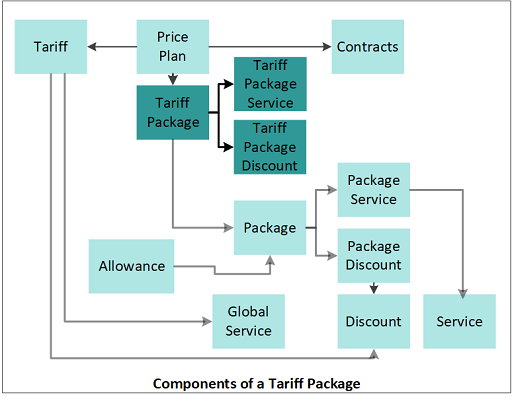
Add services and discounts to a tariff via a tariff package
Tariff Links
Discount schemes, packages can be linked to tariffs, and tariffs can be linked to a price plan:
-
Tariff Packages
A CMP
Converged Monetisation Platform. The MDS Global product that supports customer care and billing for digital service providers. package is a collection of allowances, services and/or discounts that can be added to a subscription. These are used primarily in B2B Business to business.
The exchange of products, services or information between businesses, rather than between businesses and consumers. to provide personalised pricing. Packages created in CMP must be linked to the required tariff to be available for selection when a price plan to which the tariff is linked is chosen. If a package and a tariff are not linked, and the tariff is not linked to the price plan, the package cannot be selected. Services are added to the tariff package from the linked package; the service price can be amended when it is added to a tariff package. The added services are called tariff package services. Services that are not in the package cannot be added to the tariff package. Note: Shared bolt-on
An addition to a subscriber's main plan or product; also sometimes called an add-on. packages cannot be linked to tariffs.Discounts are added to the tariff package from the linked package; the discount price cannot be amended when it is added to a tariff package. The added discounts are called tariff package discounts.
-
Tariff Services
Services are all chargeable and non-chargeable non-usage items in CMP. Services can be a one-off (connection fee) or recurring (line rental). Only one instance of a service can be active at any one time. Services can be global services, which can be added to any tariff, or a service that can only be applied to particular tariffs via a tariff package.
-
Tariff Discounts
Discount schemes reduce the price of services and call class groups by a percentage of the original amount or by a fixed value. Discount schemes do not alter the price of services or call class groups; instead a credit is added for the discounted amount. You can also configure a negative discount, which adds a surcharge to the subscriber
The end user of a network.. -
Tariff Spend Caps
A spend cap
A service for customers that applies a limit to how much usage a customer can consume outside of their allowances or bolt-on extras, preventing spending over a certain amount. is a service for customers that applies a limit to how much usage or usage and spend a customer In the context of the Cloud Monetisation Platform, an individual or organisation who has signed an agreement to take goods and services from a service provider. A customer receives a bill associated with one or more subscriptions, and can be a single end user or a large company with many subscriptions assigned to one agreement. can consume outside of their allowances or bolt-on extras, preventing spending over a certain amount. Tariffs with a postpaid billing type must be linked with an overage full spend cap A limit on a subscriber's service.. For more information, see Spend Caps.