High Availability
Introduction
As CMP Converged Monetisation Platform. The MDS Global product that supports customer care and billing for digital service providers. will not always be considered a business-critical support system, high availability (HA) is an option as part of a deployment and not an architecture that is deployed by default. For HA, the database operates in an Active/Passive configuration while the other parts of CMP operate in an Active/Active configuration.
Responsibilities
Deploying any system capable of high availability and managing it both day to day and in the case of a failure to ensure that it delivers that availability are by nature complex tasks that involve much more than simply a software application with the required capabilities.
A high availability CMP installation must therefore be planned, deployed and managed by staff with a full understanding of the principles involved and who take responsibility for the overall operating environment. This means that they need to:
- Appreciate the high availability strategy for each of the individual CMP components as described below.
- Design the physical and virtual servers, storage and network In the context of CMP, the infrastructure on which usage of registered customers will be measured – this could be a mobile phone network, broadband network or other non-telecommunications network. that CMP will be deployed to so that the application’s high availability strategy can be effectively leveraged.
- Configure the CMP installer so as to deploy the different CMP components to leverage the application’s high availability strategy.
- Install and manage load balancers to correctly distribute and direct network traffic across the different instances of the deployed CMP components as described below both in the case of normal operation, when one or more components has failed, and during an automated zero downtime upgrade.
- Configure file system and database replication as described below using the selected third party Of software; a reusable component developed to be either freely distributed or sold by an entity other than the original vendor of the development platform. solution.
- Manage resolution of failures and, where relevant, the manual steps required to fall back to a fully highly available configuration.
Deployment Configuration
The diagram below shows the simplest form of high availability deployment of CMP.
Click the thumbnail to expand the diagram:
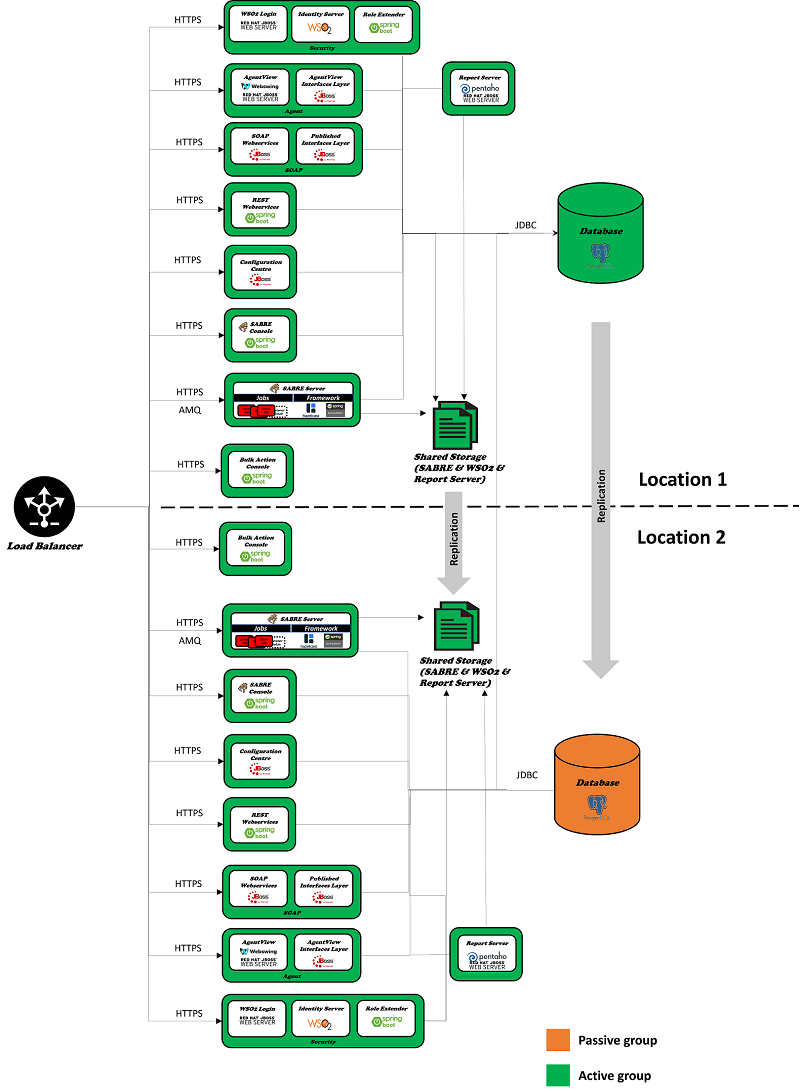
Active/Passive Configuration on Physical Infrastructure
All components are Active/Active except the Database. Configuring the replication and the load balancing is not part of the CMP deployment and needs to be configured using relevant third party software and hardware as a separate step to the installation itself.
The load balancer must be able to support certain functions. For more information, see High Availability Prerequisites in the CMP Installation Guide.
Note that the load balancer needs to be configured to expose multiple instances of the same component on a single external address. This is the case for both the external load balancer related components and the internal load balancer configured for micro services.
Zero Downtime Upgrade
The CMP installer will automatically upgrade an HA deployment with zero downtime. For this to work, the following must be in place:
-
Two phases of the database upgrade (one before any software update and one after all software updates).
-
The Load Balancer configured to reference the CMP Health Check service such that the upgrade process can sequentially take components offline, upgrade them and bring them back online.
Note that the automated upgrade process does not include management of Linux A well-known widely used open source operating system. or PostgreSQL database major version upgrades, which are the responsibility of the customer In the context of the Cloud Monetisation Platform, an individual or organisation who has signed an agreement to take goods and services from a service provider. A customer receives a bill associated with one or more subscriptions, and can be a single end user or a large company with many subscriptions assigned to one agreement..